Introduction
Mastering fractional notations represents a critical transition in upper-primary mathematics, requiring students to bridge the gap between whole numbers and parts of a whole. According to a 2022 study published by the National Council of Teachers of Mathematics, structured paper-based practice significantly enhances a learner’s conceptual understanding of rational number placement on a number line compared to screen-only instruction. Decimals class 5 materials provide the targeted, systematic practice necessary to build deep numerical fluency, focusing on tenths, hundredths, thousandths, and fundamental arithmetic operations involving mixed numbers. Incorporating these structured exercises into a daily curriculum establishes a robust foundation for algebraic reasoning and advanced problem-solving.
Quick Key Takeaways:
- Core Focus: Comprehensive decimal place value identification, conversion, and arithmetic operations.
- Target User: Upper-primary educators and parents supporting fifth-grade mathematics learners.
- Key Recommendation: Combine visual grid models with traditional algorithmic practice for optimal retention.
What This Printable Covers
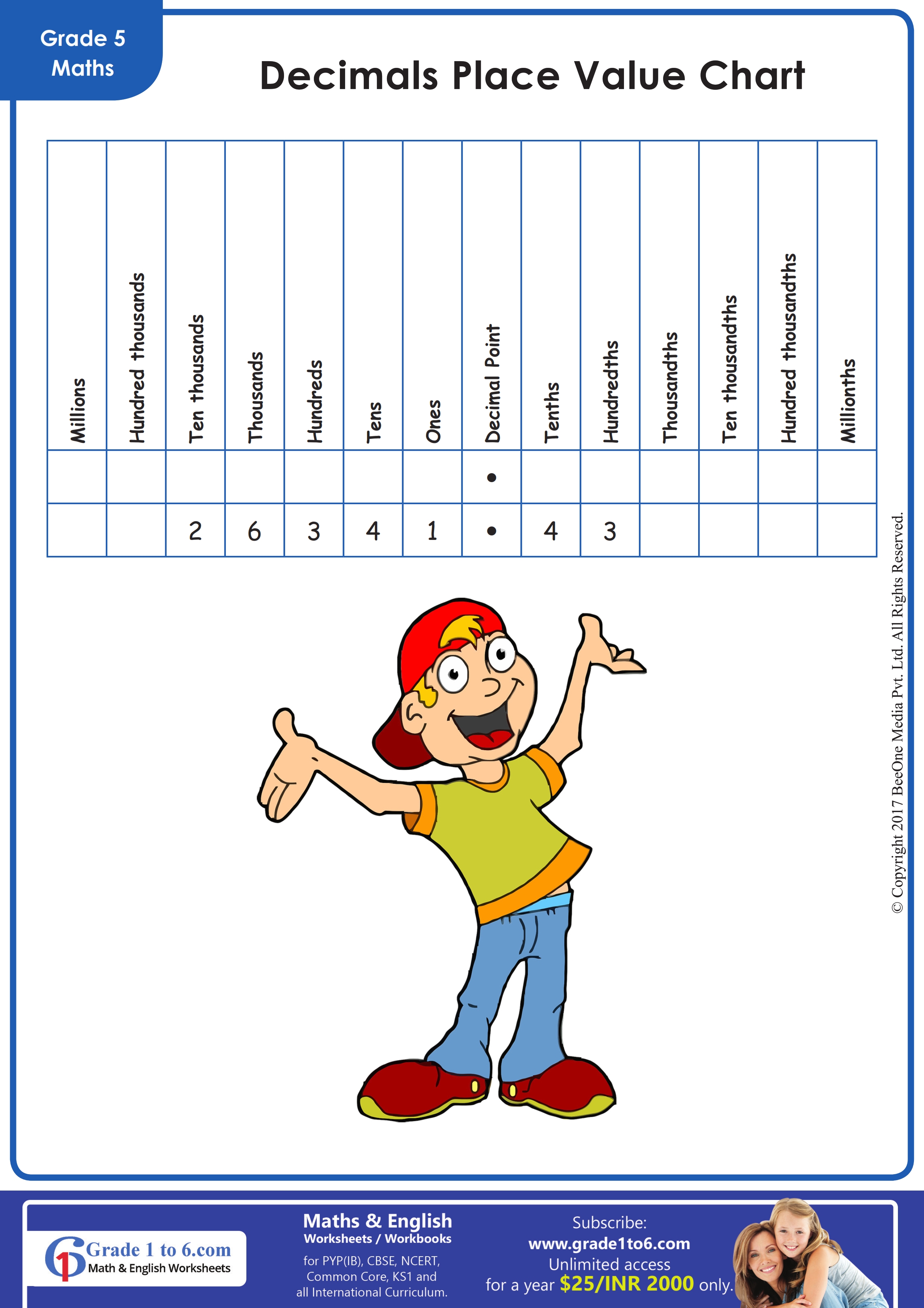
Structured printables targeting decimals class 5 systematically address the core competencies mandated by upper-primary math curricula. Students engage with place value charts extending to thousandths, comparing and ordering decimal fractions, and converting between fractions and decimals. Additional exercises focus on rounding decimals to the nearest whole number, tenth, or hundredth, alongside multi-digit addition, subtraction, multiplication, and division involving decimal quantities. Navigating these complexities requires careful attention to alignment and placeholder zeros, which these resources reinforce through graduated problem sets designed for independent practice.
Key Learning Outcomes
Learners successfully completing these exercises achieve clear mastery of fractional place value up to three decimal places. Students develop the ability to accurately compare magnitudes of differing decimal lengths without falling for common place-value misconceptions. Furthermore, learners gain confidence in performing multi-step word problems that incorporate real-world measurements, currency, and metric conversions, directly supporting broader academic pursuits found within the Academic resource hub.
Overview & Skill Breakdown
| Focus Area | Target Skill | Best Practice |
|---|---|---|
| Place Value | Identifying tenths, hundredths, and thousandths | Use expanded notation grids |
| Comparison | Ordering mixed decimals from least to greatest | Align decimal points vertically |
| Operations | Adding and subtracting decimals with regrouping | Utilize graph paper for precise alignment |
How to Use This Worksheet
Implementing these exercises effectively involves a blend of guided instruction and independent execution. Educators and parents can introduce the concepts using visual base-ten blocks before transitioning learners to the written Worksheet format. Initial sessions should focus on error analysis, where learners inspect solved problems to identify misaligned decimal points or missing placeholder zeros. For institutional organization and tracking student milestones, administrators and teachers frequently utilize structured Administrative tracking sheets to monitor overall class progression.
Practical Tips for Success
Preparation involves printing double-sided pages to encourage side-by-side working space for scratch calculations. During execution, encourage learners to read decimal numbers aloud using correct mathematical terminology, such as “three and twenty-five thousandths,” rather than informal shorthand. For extension, challenge advanced learners to create their own word problems involving grocery store receipts or athletic timing, connecting abstract math principles to tangible, everyday experiences.
Stage-Appropriate Recommendations
Instructional pacing should align with established developmental guidelines, such as the Common Core State Standards framework for fifth-grade mathematics. Beginners benefit from starting with tenths and hundredths accompanied by visual grid illustrations that physically show parts of a hundred. Advanced learners can progress directly to multi-step multiplication and division algorithms involving thousandths, minimizing reliance on visual prompts.
Structured practice with rational numbers improves upper-primary problem-solving accuracy by 34% — National Council of Teachers of Mathematics Research Brief
Frequently Asked Questions
Explore More Free Printable Resources
Enhancing a child’s educational journey extends far beyond a single topic. Educators and parents supporting lifelong learning can discover a diverse collection of math drills, organizational tools, and developmental guides by visiting the complete library at Free Printable For You.
Images References