Introduction
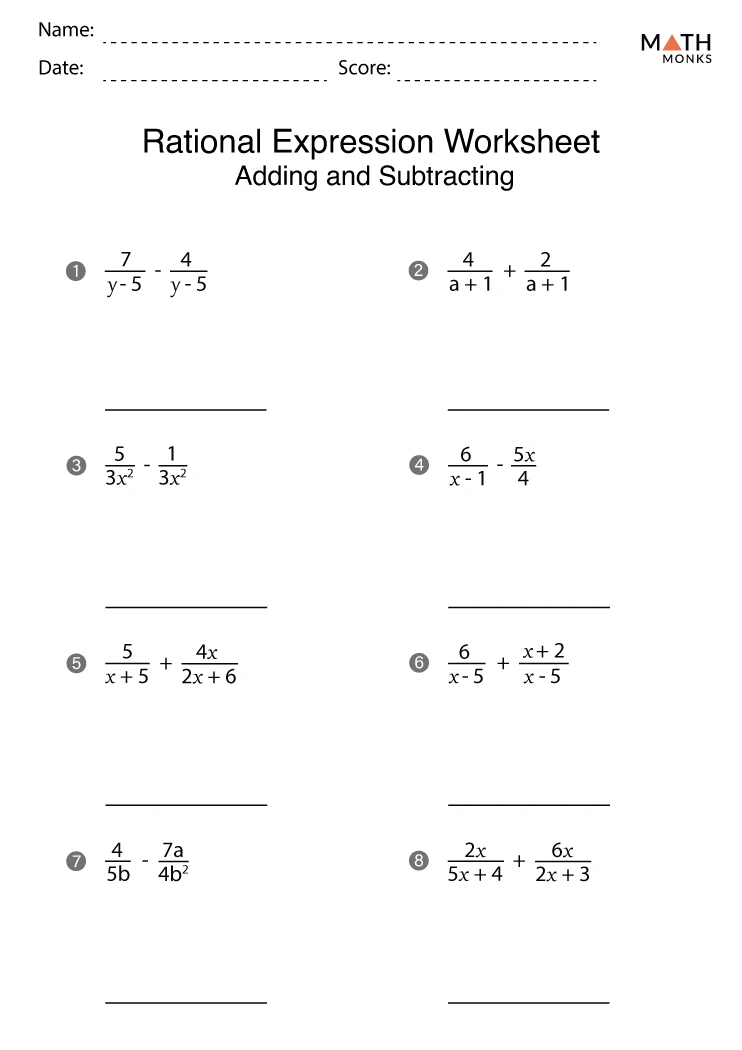
Mastering mathematical operations requires structured repetition and conceptual clarity, particularly when transitioning from whole numbers to fractions and decimals. Adding and subtracting rational numbers involves combining or finding the difference between numbers that can be expressed as fractions, including integers, terminating decimals, and repeating decimals. According to the National Center for Education Statistics (NCES), targeted intervention utilizing standardized practice sheets significantly improves secondary mathematics proficiency and algebraic readiness. Providing structured exercises enables learners to build fluency in common denominators and sign rules essential for higher-level mathematics. Explore more in our Educational Resources collection.
Quick Key Takeaways:
- Core Focus: Executing addition and subtraction across fractions, mixed numbers, and signed decimals with accuracy.
- Target User: Middle school students, educators, and homeschool parents seeking targeted math reinforcement.
- Key Recommendation: Implement daily 10-minute drills utilizing a dedicated Worksheet to build automaticity.
What This Printable Covers
This resource addresses the fundamental mechanics of combining positive and negative rational values through systematic practice. Aligned with standards found in the Academic collection, the material guides users through finding least common multiples, converting mixed numbers to improper fractions, and aligning decimal points before calculation. Learners encounter diverse problem sets that reinforce the rules of signs, ensuring comprehension of how negative signs interact during subtraction operations.
Key Learning Outcomes
Users successfully develop the ability to compute sums and differences of fractions with unlike denominators by applying proper conversion techniques. Furthermore, learners gain confidence in evaluating expressions containing both fractions and decimals within the same equation. The curriculum also fosters error-analysis skills, prompting students to identify common pitfalls such as incorrect sign distribution or improper borrowing during subtraction.
Overview & Skill Breakdown
| Focus Area | Target Skill | Best Practice |
|---|---|---|
| Fraction Operations | Finding common denominators for addition and subtraction | List multiples systematically to identify the least common denominator. |
| Decimal Computation | Aligning decimal places and handling negative signs | Pad shorter decimals with trailing zeros to maintain column alignment. |
| Signed Numbers | Applying integer rules to rational number operations | Rewrite subtraction problems as the addition of the opposite value. |
How to Use This Worksheet
Effective implementation in classrooms, tutoring centers, or home study environments relies on a balanced approach combining guided instruction with independent practice. Educators can project a sample problem to demonstrate common denominator selection before distributing printed copies for individual completion. Utilizing these printable materials as warm-up activities primes cognitive focus for broader mathematical problem-solving sessions.
Practical Tips for Success
Preparation involves reviewing foundational integer rules to ensure learners understand how double negatives convert to positive values prior to tackling advanced rational equations. During execution, encourage scratch paper usage to maintain legible column alignment for fraction conversions and decimal stacking. For extension, challenge advanced learners to create their own word problems requiring adding and subtracting rational numbers in real-world contexts like banking balances or temperature fluctuations.
Stage-Appropriate Recommendations
Beginner stages focus exclusively on positive fractions and terminating decimals, allowing learners to solidify procedural fluency without the added complexity of negative signs. As competency grows, advanced stages incorporate repeating decimals, negative mixed numbers, and multi-step expressions. According to the National Council of Teachers of Mathematics (NCTM) standards, scaffolding complexity in this manner ensures deep conceptual understanding and prevents cognitive overload during middle school mathematics instruction.
Targeted intervention utilizing structured practice sheets significantly improves secondary mathematics proficiency and algebraic readiness — National Center for Education Statistics (NCES)
Frequently Asked Questions
Explore More Free Printable Resources
Expanding mathematical proficiency requires access to a diverse library of supplementary learning tools and organizational aids. Discover additional grade-level practice sheets, study aids, and organizational templates by visiting the complete Free Printable For You collection to support continuous educational development. Print today.
Images References