Introduction
Mastering algebraic operations requires consistent repetition and structured progression through increasingly complex fraction forms. According to the Institute of Education Sciences (IES), systematic daily practice with targeted math problems significantly improves procedural fluency and conceptual retention in high school mathematics. Adding and subtracting rational expressions involves combining algebraic fractions through finding least common denominators, factoring polynomials, and simplifying numerators. This essential algebraic process builds directly upon foundational fraction arithmetic learned in earlier grades while introducing variable denominators that demand rigorous attention to domain restrictions.
Quick Key Takeaways:
- Core Focus: Combining algebraic fractions through common denominators and polynomial simplification.
- Target User: High school algebra students and educators seeking structured practice materials.
- Key Recommendation: Factor all denominators completely before attempting to find the lowest common denominator.
What This Printable Covers
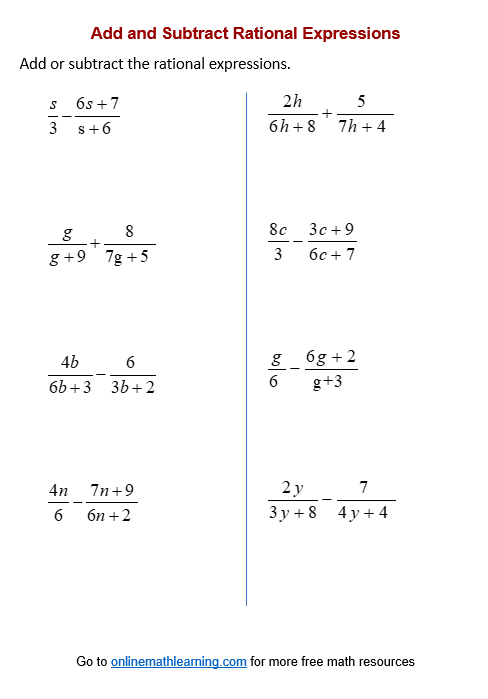
Structured learning materials targeting this topic focus on bridging the gap between basic arithmetic fractions and advanced polynomial manipulation. According to the Common Core State Standards Initiative framework for high school mathematics, students must develop proficiency in rewriting rational expressions in equivalent forms. This specific Worksheet collection guides learners through problems with like denominators, unlike monomial denominators, and complex binomial denominators requiring advanced factorization techniques. Each section is intentionally designed to isolate specific skill gaps, ensuring that students thoroughly understand the mechanics of sign distribution and numerator expansion before tackling multi-step polynomial combinations.
Key Learning Outcomes
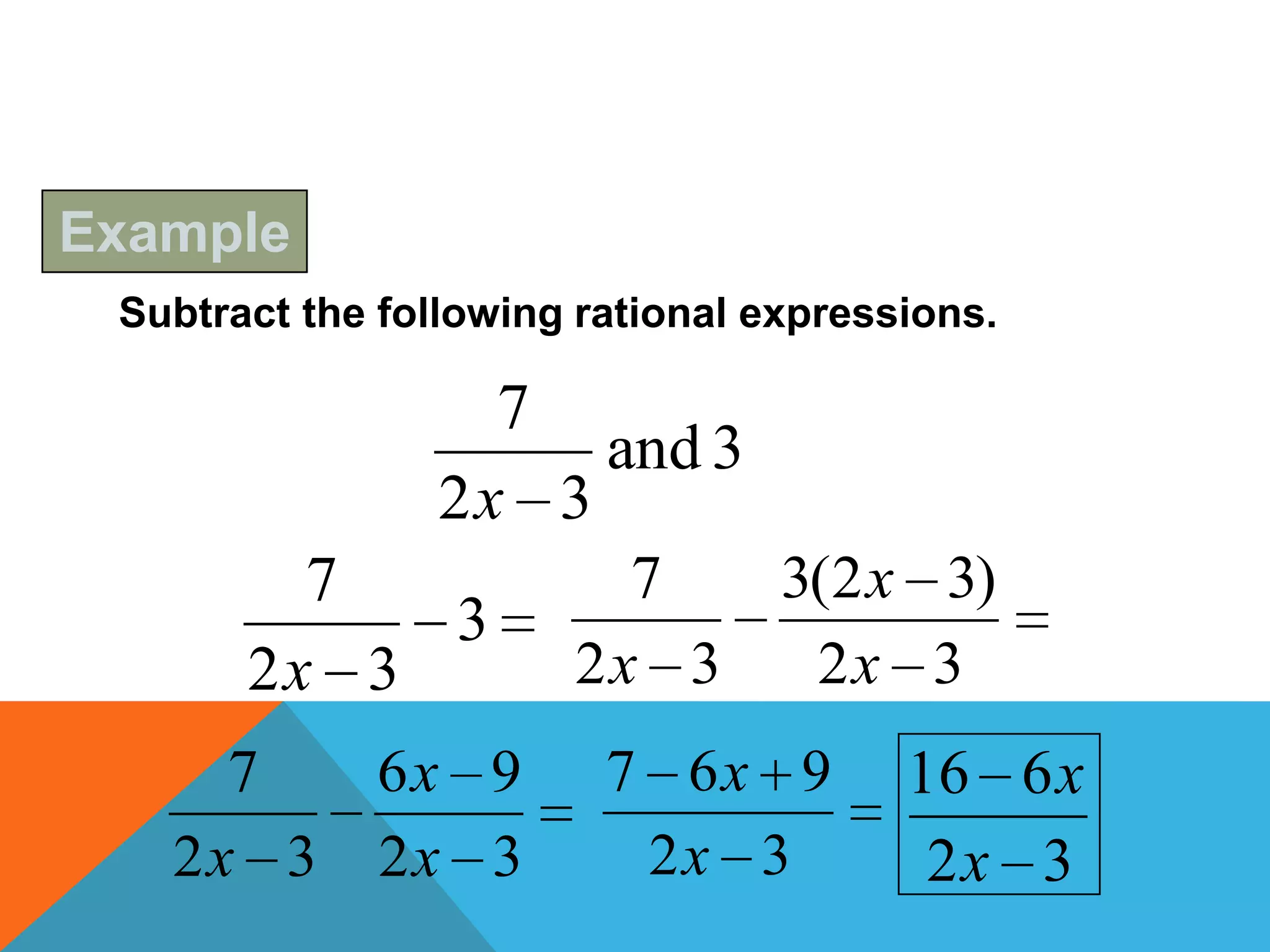
Working through these carefully curated exercises allows learners to accurately identify least common multiples among polynomial expressions. Students master the critical step of determining excluded values to maintain domain integrity throughout each calculation. Furthermore, the practice reinforces accurate distribution of negative signs across binomial numerators during subtraction operations, drastically reducing common arithmetic errors.
Overview & Skill Breakdown
| Focus Area | Target Skill | Best Practice |
|---|---|---|
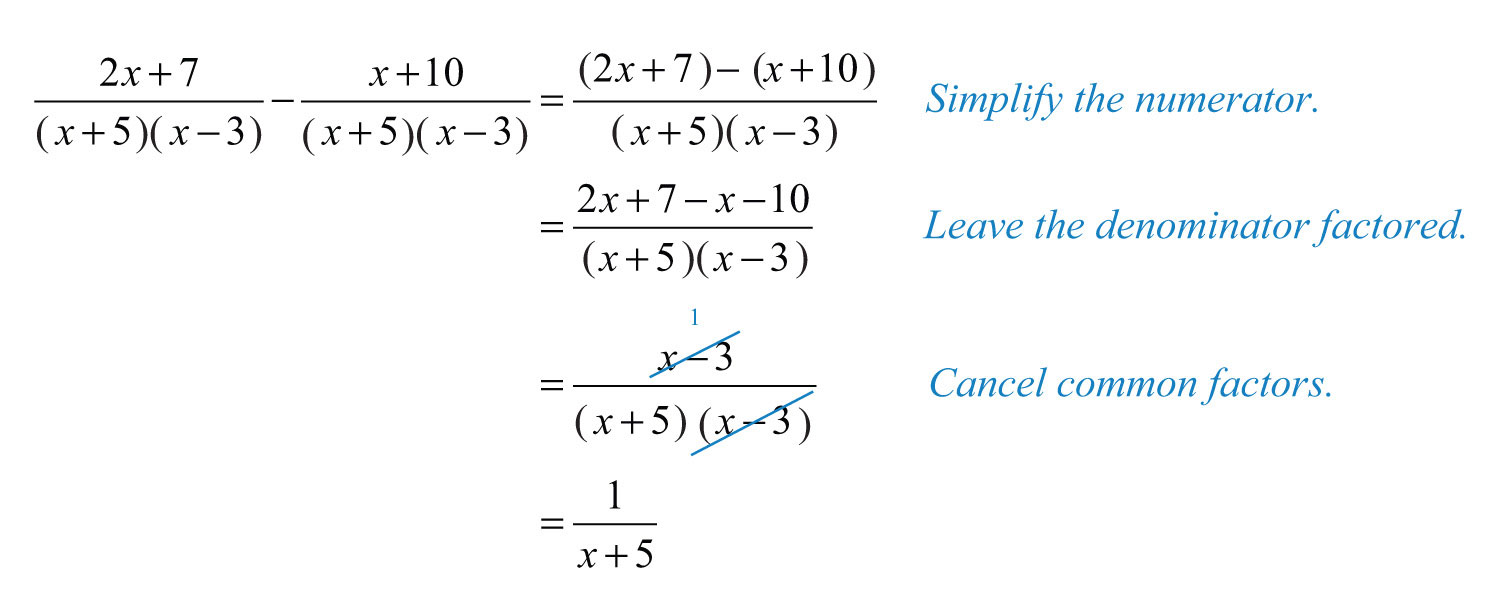
| Like Denominators | Combining numerators directly | Keep denominators unchanged while simplifying the resulting numerator |
| Monomial Denominators | Finding least common multiples | Identify numerical coefficients and highest variable powers separately |
| Binomial Denominators | Factoring and expanding | Factor completely before searching for shared binomial factors |
How to Use This Worksheet
Implementing these printable resources effectively requires a blend of guided instruction and independent problem-solving sessions. Educators and parents can integrate these printables into daily warm-ups, homework assignments, or targeted intervention groups to reinforce classroom instruction. For broader educational planning, additional materials can be found within the Academic resource category. Reviewing previous prerequisite skills ensures readiness before attempting complex subtraction problems.
Practical Tips for Success
Preparation involves printing clear copies and providing scrap paper for extensive polynomial factorization steps. During execution, encourage learners to write out every intermediate step, particularly when distributing negative signs across subtraction problems, to prevent careless algebraic mistakes. For extension, challenge advanced learners to create their own custom rational expression problems with unique denominator combinations to test peers.
Stage-Appropriate Recommendations
Scaffolding algebraic complexity ensures that learners build confidence without becoming overwhelmed by multi-variable polynomials. Aligned with the National Council of Teachers of Mathematics (NCTM) procedural fluency standards, beginner stages prioritize problems with shared monomial denominators and basic linear binomials. Advanced stages introduce quadratic denominators requiring factoring by grouping or quadratic formulas, alongside identifying domain restrictions. This methodical progression guarantees sustainable cognitive load management and long-term mastery.
Systematic daily practice with targeted math problems significantly improves procedural fluency and conceptual retention in high school mathematics. — Institute of Education Sciences (IES)
Frequently Asked Questions
How do I download this printable? Click the download button on the resource page to save the high-resolution PDF file directly to your device for immediate printing.
What is the practical benefit of this exercise? It strengthens polynomial factoring skills and fractional manipulation required for advanced calculus and STEM coursework.
Is this aligned with recognized educational frameworks? Yes, the design follows National Council of Teachers of Mathematics procedural fluency guidelines for secondary algebra.
Explore More Free Printable Resources
Enhance your educational toolkit by browsing the extensive collection available at Free Printable For You, where thousands of organized assets support lifelong learning and academic excellence.
Images References