Introduction
Mastering multi-digit arithmetic requires structured organizational strategies that bridge concrete counting and abstract calculation. Adding with regrouping, frequently termed carrying, represents a fundamental operational shift where sums exceeding nine in a single place value transfer excess value to the next column. According to the National Center for Education Statistics, students who secure early fluency in base-ten place value concepts demonstrate significantly higher longitudinal proficiency in advanced algebraic reasoning. Structured print assets provide the repetitive, visual scaffolding necessary to transform this complex cognitive procedure into reliable academic practice.
Quick Key Takeaways:
- Core Focus: Mastering the algorithmic transfer of values across place value columns during addition.
- Target User: Elementary educators and homeschooling parents seeking targeted arithmetic reinforcement.
- Key Recommendation: Pair physical base-ten blocks with structured worksheet grids before transitioning to abstract paper-only calculations.
What This Printable Covers
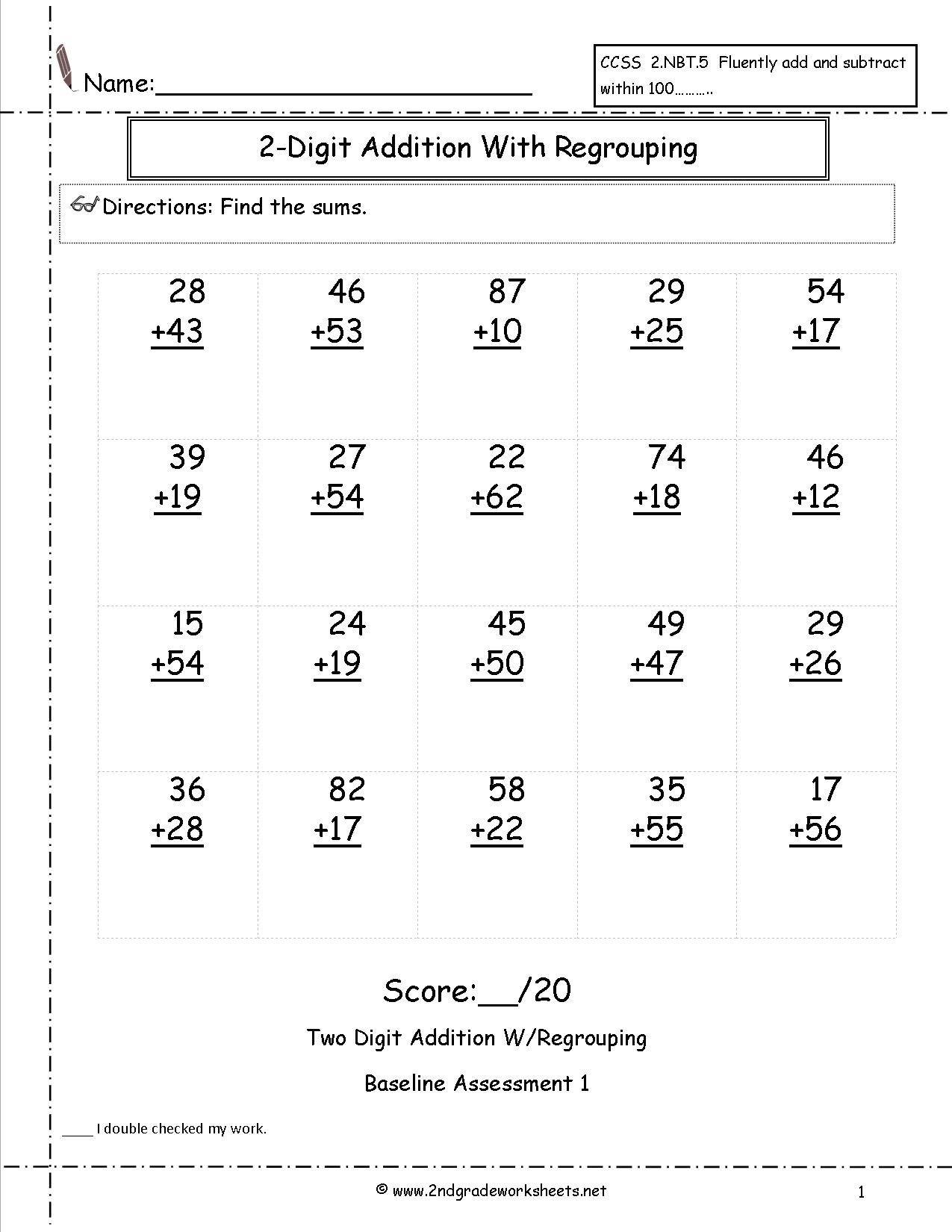
This resource delivers targeted exercises designed to reinforce column-by-column addition involving two-digit and three-digit numbers. By organizing problems within explicit grid layouts, learners isolate individual place values from ones to hundreds. The curriculum aligns with modern educational standards emphasizing conceptual understanding alongside procedural fluency, ensuring learners grasp why the carried digit moves rather than merely following a memorized sequence. Such targeted Academic practice builds vital confidence for larger numerical operations.
Key Learning Outcomes
Learners systematically identify when a column sum reaches or exceeds ten, triggering the necessity for value exchange. They accurately place the remainder digit in the current column while cleanly migrating the tens value upward to the adjacent column. Furthermore, students consistently verify their calculations through estimation and inverse subtraction checks. Ultimately, these exercises develop sustained attention to detail and neat organizational habits across varied mathematical tasks.
Overview & Skill Breakdown
| Focus Area | Target Skill | Best Practice |
|---|---|---|
| Place Value Alignment | Vertical column organization | Utilize grid lines to prevent horizontal shifting errors. |
| Regrouping Mechanics | Carrying values across columns | Circle the carried digit to ensure visual inclusion during addition. |
| Error Analysis | Identifying missing carry steps | Review completed sheets by working backward through subtraction. |
How to Use This Worksheet
Implementation requires a gradual release model where adults first demonstrate the mechanical steps aloud while completing the initial two problems. Learners then tackle intermediate rows independently while utilizing physical counters or tally marks if hesitation arises. Once the routine becomes familiar, these sheets integrate seamlessly into morning work rotations, center-based stations, or targeted home review sessions. Educators often pair these printables with foundational Early Learning number-sense tools to bridge elementary gaps.
Practical Tips for Success
Preparation involves laminating master copies or printing duplicate sets for repeated dry-erase practice to reduce paper waste and math anxiety. Execution proceeds most smoothly when learners use colored pencils specifically for the carried digits, visually distinguishing them from the primary addends. For meaningful extension, encourage learners to write their own word problems matching the numeric equations on the page, connecting abstract calculations to real-world scenarios.
Stage-Appropriate Recommendations
Beginner learners benefit from expanded notation layouts that explicitly separate tens and ones columns before introducing standard compressed addition algorithms. Advanced learners transition toward three-digit and four-digit problems featuring consecutive regrouping across multiple adjacent columns. According to the National Association for the Education of Young Children (NAEYC) developmental standards, mathematics instruction for young children must intentionally connect physical manipulation of quantities with symbolic written notations to ensure long-term retention.
Longitudinal impact of foundational place-value instruction on advanced mathematical reasoning — National Center for Education Statistics
Frequently Asked Questions
- How do I download this worksheet? Click the download link on the resource page to save the secure PDF directly to your device.
- What is the practical benefit of regrouping practice? It builds the core multi-digit computational fluency required for everyday financial and scientific tasks.
- Which trusted framework guides these printables? Designs adhere strictly to NAEYC developmental guidelines and recognized elementary math standards.
Explore More Free Printable Resources
Expanding a study routine requires access to diverse, well-organized materials that support every stage of development. Beyond standard math drills, educators and learners can access specialized organizational forms via the Administrative category or discover motivational tools within Personal Growth. Every single practice page, chart, and template is housed conveniently inside the master Free Printable For You library.
Images References