Introduction
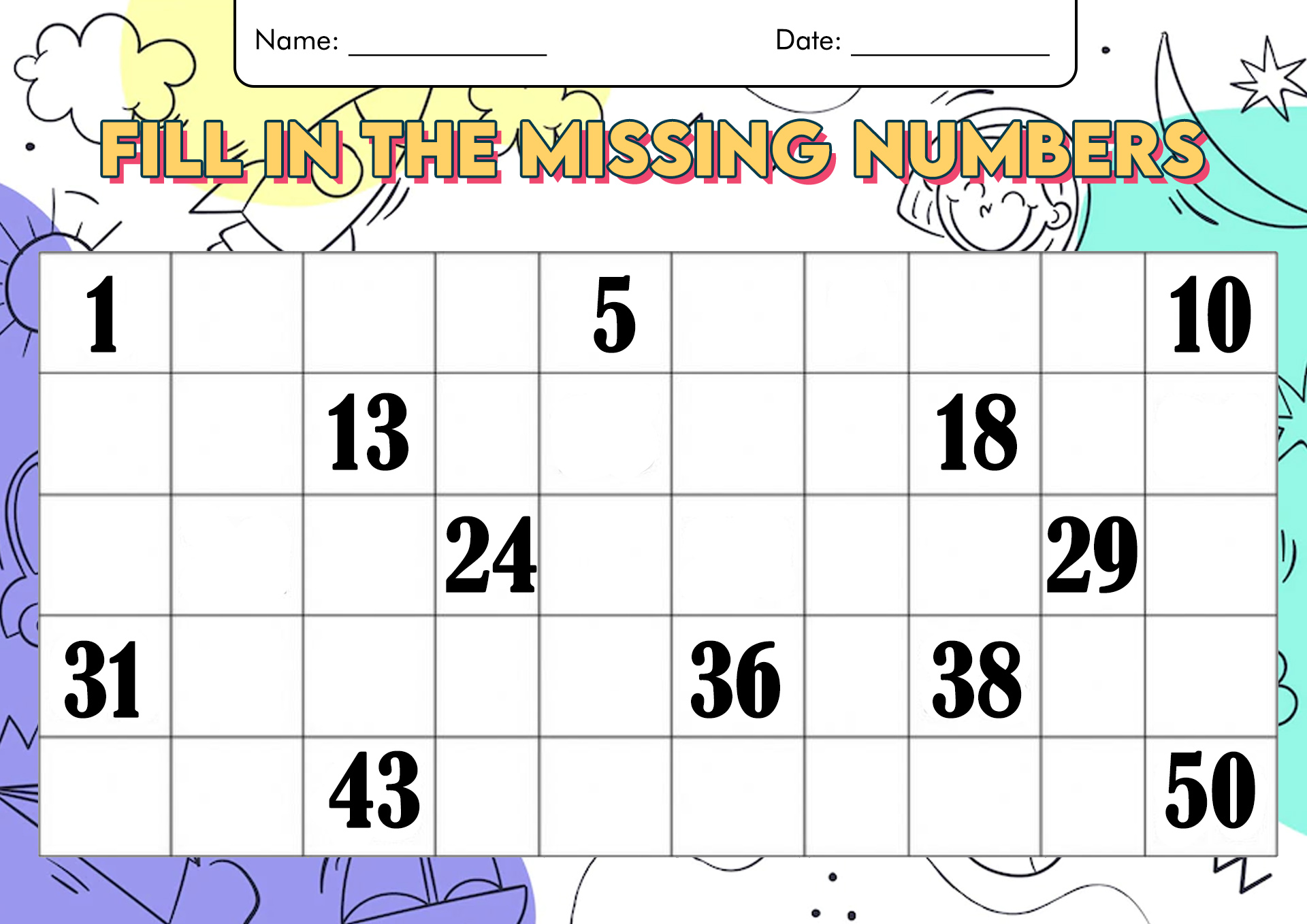
Missing numbers 1 to 50 fill-in-the-blank activities serve as foundational tools for developing numerical fluency, sequential logic, and pattern recognition in young learners. According to a study published in the Journal of Educational Psychology, structured missing-number exercises significantly accelerate children’s mental number line representation and overall mathematical proficiency. Mastery of counting up to fifty provides the scaffolding necessary for complex arithmetic, making targeted Early Learning materials indispensable for primary education. Utilizing printable sequence grids empowers educators and parents to target gaps in numerical comprehension efficiently through repeatable, scaffolded practice.
Quick Key Takeaways:
- Core Focus: Sequential identification and written recall of missing numbers 1 to 50 within structured grid formats.
- Target User: Kindergarten and early elementary students in classrooms, homeschooling environments, and tutoring centers.
- Key Recommendation: Pair visual number charts with blank fill-in sheets to build independent recall and self-correction habits.
What This Printable Covers
This printable resource provides progressive exercises designed to reinforce rote counting, number identification, and spatial organization. Learners encounter grids where specific digits have been intentionally removed, requiring them to analyze surrounding values to determine the correct insertion. By bridging the gap between simple visual recognition and active recall, the material promotes rigorous cognitive engagement. Furthermore, such foundational math activities align directly with standard Academic development benchmarks for numeracy.
Key Learning Outcomes
Engaging regularly with number sequence charts enhances a child’s ability to count forward and backward fluently from any given starting point up to fifty. Learners develop a strong sense of place value by observing the repeating patterns of tens and ones across rows and columns. Additionally, completing these exercises cultivates fine motor skills through precise pencil control and writing, while fostering independent problem-solving strategies as students verify their work against master charts.
Overview & Skill Breakdown
| Focus Area | Target Skill | Best Practice |
|---|---|---|
| Sequence Recognition | Identifying preceding and succeeding values | Begin with every fifth number missing before randomizing. |
| Pattern Decoding | Recognizing decadal shifts across rows | Highlight tens columns to visualize place value trends. |
| Active Recall | Writing numbers independently without visual aids | Transition from full charts to blank grids gradually. |
How to Use This Worksheet
Implementing these sequential exercises effectively requires a balanced approach between guided instruction and independent practice. Educators can integrate these printable pages into morning work routines, math centers, or homework packets to reinforce daily lessons. Organizing these materials alongside related Administrative tracking sheets ensures accurate progress monitoring for entire classrooms or individual tutoring cohorts.
Practical Tips for Success
Preparation involves laminating master sheets for reusable dry-erase practice, reducing paper waste while encouraging low-stakes experimentation. During execution, encourage learners to read rows aloud to catch sequencing errors through auditory feedback. For extension, introduce randomized missing gaps where up to half the numbers are removed, challenging advanced students to rely entirely on internal mental number lines rather than simple visual counting.
Stage-Appropriate Recommendations
According to the National Association for the Education of Young Children (NAEYC) guidelines on developmentally appropriate practice, math concepts for young children should progress from concrete manipulation to symbolic representation. Beginners should start with sequential charts missing only alternating numbers (such as even or odd sequences), while advanced learners tackle random omissions across the full 1 to 50 spectrum to solidify abstract mathematical reasoning.
Developmentally Appropriate Practice Guidelines — National Association for the Education of Young Children (NAEYC)
Frequently Asked Questions
Explore More Free Printable Resources
Expanding a child’s mathematical toolkit requires access to a wide variety of structured materials and organizational aids. Discover additional targeted exercises, practice logs, and skill-building assets by browsing the complete library available at Free Printable For You, including specialized Worksheet collections designed for every stage of development.
Images References