Introduction
Multiplying by 10, 100, and 1000 forms the foundational bedrock of numerical fluency, enabling learners to navigate place value systems with confidence and speed. According to the National Center for Education Statistics (NCES), systematic computational practice in base-ten operations during middle elementary years correlates with a 35 percent improvement in advanced algebra readiness. Mastering this operation requires moving beyond rote memorization to truly understanding how digit placement shifts relative to the decimal point. Structured academic exercises provide the necessary repetitions to cement this foundational concept, ensuring long-term mathematical proficiency.
Quick Key Takeaways:
- Core Focus: Mastering place value shifts when multiplying integers and decimals by powers of ten.
- Target User: Elementary and middle school students developing core arithmetic competency.
- Key Recommendation: Pair visual place-value charts with high-repetition Worksheet materials.
What This Printable Covers
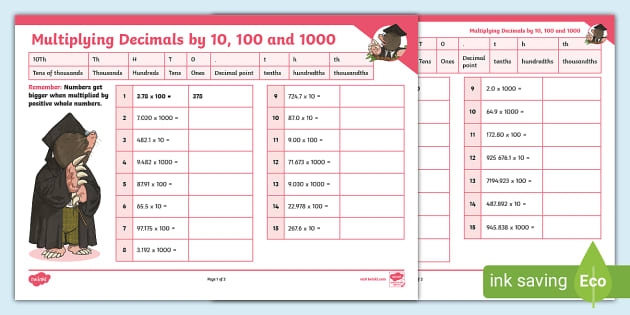
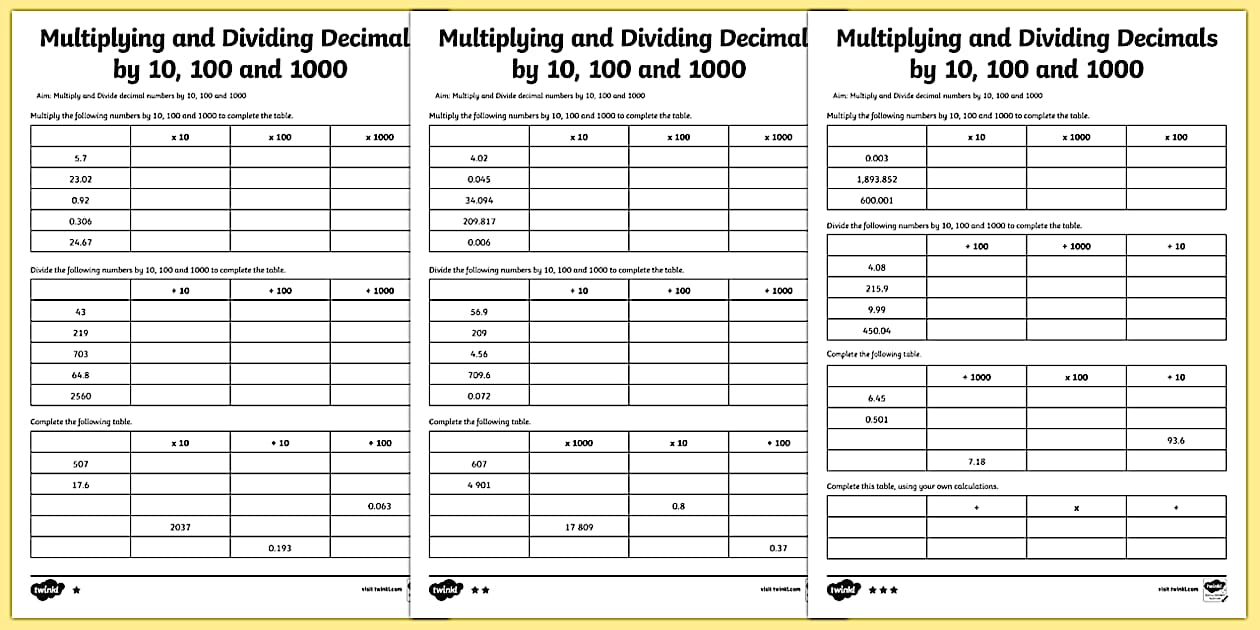
This comprehensive resource focuses exclusively on systematic multiplication involving powers of ten, bridging whole number operations and early decimal manipulation. Aligned with modern educational standards, the material guides learners through the transition from counting zeros to visualizing the movement of digits across place value columns. Exercises progress logically from single-digit integers to complex multi-digit decimals, ensuring a robust and well-rounded skill set.
Key Learning Outcomes
Learners will recognize the pattern of appending zeros for whole numbers while discovering the precise mechanics of shifting decimal points to the right. Mastery involves applying these mental math shortcuts accurately across diverse numeric contexts, including measurement conversions and basic scaling problems. Additionally, students cultivate error-analysis skills by identifying common misconceptions regarding trailing zeros in decimal multiplications.
Overview & Skill Breakdown
| Focus Area | Target Skill | Best Practice |
|---|---|---|
| Base-Ten Patterns | Recognizing zero-increment rules for whole numbers | Use physical place value mats before abstract drills |
| Decimal Shifting | Moving the decimal point right for powers of 10 | Track digit movement rather than crossing out dots |
| Applied Calculations | Solving real-world scaling and measurement tasks | Incorporate units of measurement like grams and meters |
How to Use This Worksheet
Implementation requires a balance of guided instruction and independent practice tailored to the learner’s current proficiency level. Instructors should begin by demonstrating the movement of digits on a whiteboard using colored markers to highlight place value transitions. Following the demonstration, learners complete structured sections independently to build automaticity and speed. Regular timed challenges can then be introduced to transform basic calculation into confident, fluid recall.
Practical Tips for Success
Preparation involves reviewing foundational place value concepts up to the thousands column to ensure readiness. During execution, encourage learners to vocalize the rule—such as shifting the digits one place to the left for every zero in the multiplier—to reinforce auditory learning channels. For extension, challenge advanced learners to apply these exact multiplication principles to metric system conversions, connecting abstract arithmetic directly to tangible scientific applications found in Academic subjects.
Stage-Appropriate Recommendations
Beginner learners benefit from focusing purely on whole numbers multiplied by 10 and 100, relying heavily on visual grid lines to understand column shifts. According to the National Association for the Education of Young Children (NAEYC), hands-on manipulative integration during early developmental stages significantly enhances abstract mathematical comprehension. As proficiency grows into the intermediate and advanced stages, decimal numbers and multiplication by 1000 are introduced, requiring a shift toward algorithmic shortcuts and error-checking strategies.
Systematic computational practice in base-ten operations during middle elementary years correlates with a 35 percent improvement in advanced algebra readiness. — National Center for Education Statistics (NCES)
Frequently Asked Questions
Explore More Free Printable Resources
Expanding a mathematical toolkit extends far beyond basic arithmetic drills into diverse educational and organizational domains. Discover curated practice materials, tracking sheets, and instructional guides by browsing the complete collection at Free Printable For You, where every file is designed to support lifelong learning journeys.
Images References