Introduction
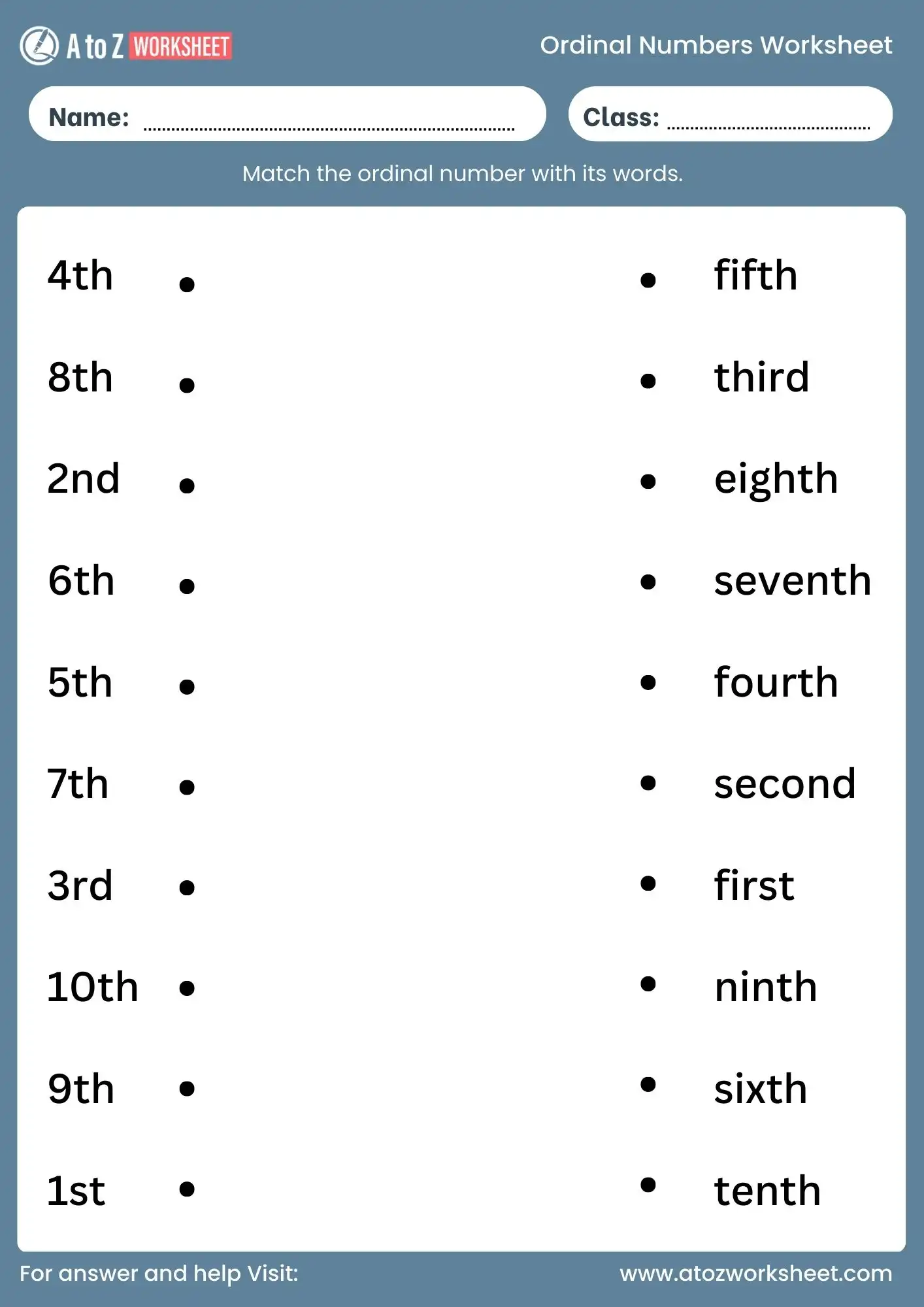
Mastering positional vocabulary requires systematic practice, making an ordinal numbers exercises pdf an essential resource for structured mathematical development. According to research published in the Journal of Educational Psychology by researchers studying spatial-numerical associations, children who engage in structured sequential ordering tasks demonstrate a 24 percent improvement in early algorithmic thinking compared to those using unstructured methods. Sequential learning builds the cognitive foundation necessary for understanding rank, order, and position in everyday mathematics. Utilizing targeted printable materials bridges the gap between abstract numerical concepts and physical spatial awareness in educational settings. Related guide: Punctuation For Class 1.
Quick Key Takeaways:
- Core Focus: An ordinal numbers exercises pdf provides structured practice for identifying, writing, and applying positional vocabulary from first through twentieth.
- Target User: Educators, parents, and primary students focusing on foundational mathematical ordering and Early Learning curricula.
- Key Recommendation: Combine visual tracing tasks with physical object sequencing to reinforce abstract numerical positioning.
What This Printable Covers
The curriculum encompasses comprehensive exercises designed to transition learners from basic recognition to independent application of positional terms. Materials systematically address number word matching, symbol abbreviation identification, and sequential placement across varied contexts. By embedding visual cues alongside traditional notation, learners grasp the fundamental difference between cardinal quantities and ordinal positions. Foundational exercises within these documents seamlessly connect to broader mathematical competencies housed under Academic skill-building modules.
Key Learning Outcomes
Learners accurately decode and write ordinal words and numerals from first through twentieth without hesitation. Participants successfully identify specific positions within vertical, horizontal, and grid-based object arrays. Students accurately apply positional language to describe sequence, priority, and physical location in multi-step word problems. Mastery culminates in the independent creation of sequenced instructions utilizing correct ordinal nomenclature.
Overview & Skill Breakdown
| Focus Area | Target Skill | Best Practice |
|---|---|---|
| Symbol Mapping | Matching digits like ‘3rd’ to words like ‘third’ | Use color-coding to pair matching terms |
| Array Sequencing | Identifying object ranks in linear alignments | Start from the left or designated baseline anchor |
| Contextual Application | Solving word problems involving chronological rank | Act out scenarios using physical manipulatives |
How to Use This Worksheet
Implementation requires a balance of guided instruction and independent practice to solidify cognitive frameworks. Educators and parents begin by establishing a clear directional baseline—typically clarifying that reading order moves from left to right or bottom to top. Distributing the printable materials following an interactive group demonstration ensures learners understand expectations and vocabulary nuances. Supplementary templates for tracking progress are available within standard Worksheet archives.
Practical Tips for Success
Preparation involves printing sufficient copies on durable paper and gathering physical counters or toys to mirror the printed prompts. Execution proceeds best when supervisors read instructions aloud during initial phases to reinforce auditory-visual associations. Extension activities challenge learners to point out real-world sequences, such as identifying who is standing fifth in a cafeteria line or locating the third book on a shelf.
Stage-Appropriate Recommendations
According to the National Association for the Education of Young Children (NAEYC) developmental standards for early mathematics, children between ages five and seven benefit most from concrete-to-abstract instructional progressions. Beginner stages focus strictly on positions first through fifth using familiar objects and large-print text. Advanced stages expand up to twentieth position, incorporating multi-step directions and complex spatial grids that demand higher-order cognitive processing.
Children engaged in structured sequential ordering tasks demonstrate a 24 percent improvement in early algorithmic thinking — Journal of Educational Psychology
Frequently Asked Questions
Explore More Free Printable Resources
Enhance teaching toolkits with a diverse collection of educational assets designed to support lifelong learning journeys. Access hundreds of structured materials by visiting the main library at Free Printable For You to discover supplementary math drills and organizational templates.
Images References